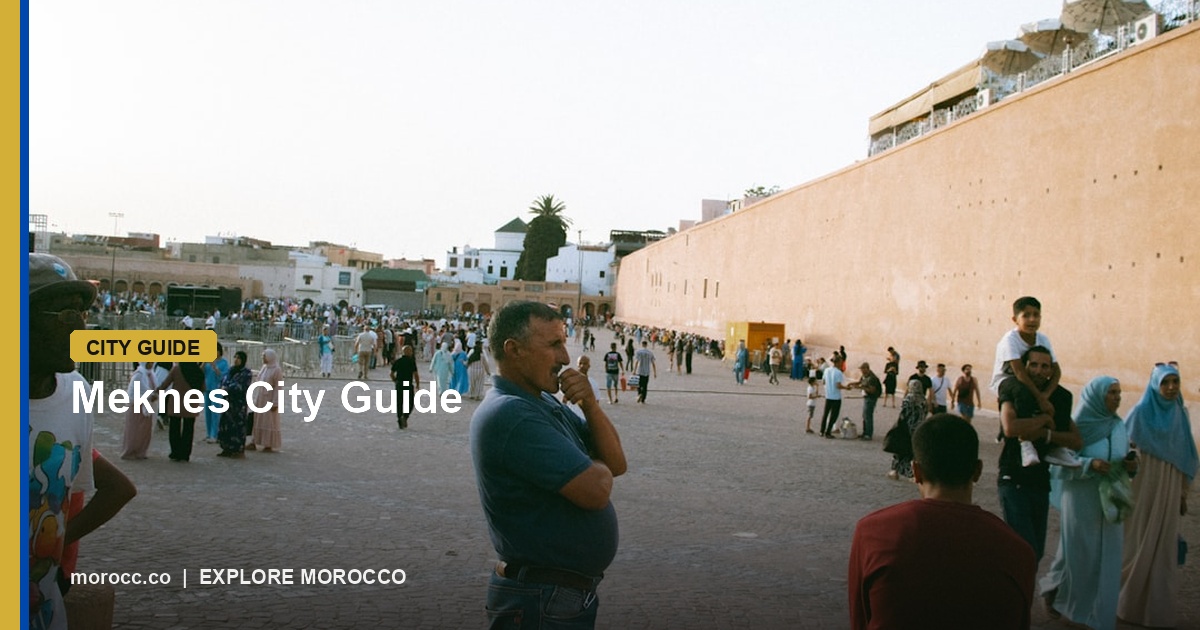
 City guide
Morocco
Meknes City Guide
Direct Answer: Born in 1061 CE as an Almoravid military stronghold and reborn under Sultan Moulay Ismail (1672–1727) as the monumental "Versailles of Morocco," Meknes pairs an 11th-centur...
Direct Answer: Born in 1061 CE as an Almoravid military stronghold and reborn under Sultan Moulay Ismail (1672–1727) as the monumental "Versailles of Morocco," Meknes pairs an 11th-century medina with a 17th-century palace-city of 40-kilometer ramparts, 12,000-horse royal stables, and the Bab Mansour gateway — a dual urban fabric UNESCO inscribed as a World Heritage Site in 1996.
Overview & Key Takeaways
Meknes (Arabic: مكناس, Maknās; Berber: ⵎⴽⵏⴰⵙ, Mknas), renowned as the "Versailles of Morocco," is one of the Kingdom of Morocco’s four historic Imperial Cities, situated in the fertile Saïss Plain of northern Morocco [1], [11], [22], [25]. Originally founded in 1061 CE by the Berber Almoravid dynasty as a strategic military stronghold (Kasbah el-Mrabtine) within the territory of the indigenous Meknassa Berber confederation [1], [3], [21], Meknes achieved world-historical prominence in the late 17th and early 18th centuries under the formidable Alaouite Sultan Moulay Ismail Ibn Sharif (r. 1672–1727) [2], [4], [5].
Over his 55-year reign, Moulay Ismail transformed Meknes into an imposing, monumental imperial capital, constructing over 40 kilometers of 15-meter-high rammed-earth ramparts, immense palatial complexes, massive grain silos and royal cavalry stables, and grandiose ceremonial gateways such as Bab Mansour el-Aleuj [2], [10], [14], [26]. In 1996, the Historic City of Meknes was inscribed on the UNESCO World Heritage List in recognition of its extraordinary urban planning that seamlessly integrates a historic 11th-century Islamic medina with a monumental 17th-century Hispano-Moorish palace-city (ville princière) [4], [7], [16].
Key Takeaways for Historians, Researchers, and Travelers
- Almoravid Military Stronghold (1061 CE): Established by the Almoravids (al-Murābiṭūn) as a garrison fortress on the trade route between the Atlantic plains and eastern Morocco, taking its name from the local Meknassa Amazigh tribe [1], [3], [21].
- Imperial Transformation under Moulay Ismail (1672–1727): The second Alaouite sultan made Meknes his royal capital, executing an ambitious construction campaign intended to rival the European court of Louis XIV at Versailles [2], [4], [11].
- State-Building and the Black Guard (Jaysh al-Abid): Moulay Ismail consolidated Moroccan sovereignty against Ottoman incursions from Algeria and expelled European colonial forces from coastal enclaves, backed by an elite permanent military force headquartered in Meknes [11], [20].
- Monumental Ramparts & Gateways: Encircled by over 40 kilometers of triple defensive ramparts up to 15 meters high, anchored by the iconic Bab Mansour el-Aleuj—one of the largest and most intricately decorated gates in the Islamic world, completed in 1732 [10], [16], [26].
- Extraordinary Hydraulic & Equestrian Infrastructure: Home to Heri es-Souani (the royal granaries and vaulted stables built to house up to 12,000 royal horses) and the Sahrij Swani (Agdal Basin), a massive 4-hectare reservoir providing water for palatial gardens and cooling [14], [24].
- UNESCO World Heritage Inscription (1996): Inscribed for its rare dual urban fabric uniting a traditional medieval Islamic medina with a massive 17th-century fortified royal residence city [4], [7], [25].
Fast Facts For Travelers
| Category | Historical Record & Specification | Primary Sources |
|---|---|---|
| City Name | Meknes (Maknās, Ville Impériale de Meknès, "The Versailles of Morocco") [1], [11] | |
| Geographic Location | Saïss Plain, Northern Morocco (between the Rif and Middle Atlas Mountains) [1], [22] | |
| Foundation Date | 1061 CE (Almoravid military garrison) [1], [21], [25] | |
| Toponymic Origin | The Meknassa (Miknasa), an indigenous Zenata Berber tribal confederation [1], [21] | |
| Imperial Capital Status | Official capital of the Alaouite Empire under Sultan Moulay Ismail (1672–1727) [2], [4], [5] | |
| Moroccan Imperial City Grouping | One of Morocco’s Four Imperial Cities (alongside Fez, Marrakech, and Rabat) [9], [12], [22], [25] | |
| UNESCO Inscription Year | 1996 (Cultural World Heritage Site #793) [4], [7], [19] | |
| Defensive Architecture | 40+ km of fortified walls, triple circuits, 15m high ramparts, 20+ monumental gates [10], [16] | |
| Principal Masterpiece Gateway | Bab Mansour el-Aleuj (commissioned by Moulay Ismail, completed 1732 by Moulay Abdallah) [16], [26] | |
| Primary Royal & Funerary Monuments | Mausoleum of Moulay Ismail, Heri es-Souani (Royal Stables & Granaries), Sahrij Swani, Qasr al-Mahkan [14], [23], [24] | |
| Nearby Archaeological Anchor | Volubilis (Walili), ancient Roman capital of Mauretania Tingitana (30 km north) [15], [18], [22] |
Geographical Setting & Regional Strategic Importance
Meknes is situated on the fertile Saïss Plain at an altitude of approximately 500 meters, cradled between the foothills of the Rif Mountains to the north and the Middle Atlas Mountains to the south [1], [22].
Strategic Geography of Meknes
- Natural Defensive Topography: The city is split by the deep valley of the Oued Bou Fekrane, which served as a natural defensive moat separating the residential medina on the western bank from the monumental royal palace-city on the eastern bank [1], [10].
- Agricultural Abundance: The rich volcanic and alluvial soil of the Saïss basin, fed by reliable mountain streams, provided abundant olive oil, wine grapes, wheat, and citrus, ensuring food security for large royal armies and cavalry [1], [14].
- Imperial Crossroad: Positioned just 60 kilometers west of Fes and 140 kilometers east of Rabat, Meknes controlled the primary east-west highway connecting the Atlantic plains to Algeria, as well as the north-south routes connecting the Mediterranean to the Sahara [1], [22].
Dynastic Evolution: From Tribal Garrison to Imperial Capital
1. The Almoravid Stronghold (1061–1147 CE)
In 1061 CE, the Almoravid dynasty (al-Murābiṭūn) under Sultan Yusuf ibn Tashfin established a military stronghold at Meknes to secure communications between the northern Rif mountains and the southern desert homelands [1], [3], [21].
- The Meknassa Tribe: The settlement arose in territory dominated by the Meknassa, an Amazigh tribal group that had earlier embraced Islamic traditions and controlled trade along eastern Morocco [1], [21].
- The Military Ribat: Known as Kasbah el-Mrabtine, this initial settlement functioned as a heavily fortified redoubt (ribat) and supply depot rather than a residential administrative capital [1], [3], [25].
2. Almohad and Marinid Urban Growth (1147–1465 CE)
Following the Almohad conquest of Morocco in 1147 CE, Meknes expanded into a recognized urban settlement [3], [9].
- Almohad Expansion: The Almohads demolished the initial Almoravid citadel during their siege, later reconstructing the Grand Mosque of Meknes and installing advanced hydraulic channels to supply public baths and neighborhood fountains [3], [12].
- Marinid Golden Age: Under the Zenata Berber Marinid dynasty (13th–15th centuries), Meknes received significant religious and scholastic investment [6], [9]. Sultan Abu Inan Faris constructed the magnificent Bou Inania Madrasa (completed c. 1351–1358 CE), a masterpiece of Islamic decorative art featuring carved cedarwood, sculpted plaster stuccowork, and elaborate geometric zellige tilework — decode these craft terms in our Moroccan architecture and craft visual glossary [9], [12].
- Saadian Neglect (16th–Early 17th Century): With the rise of the Saadian dynasty, royal attention shifted south to Marrakech and the Souss valley [6]. Meknes, along with other northern inland cities, suffered decades of economic stagnation and political neglect as royal construction budgets were directed to southern monuments [6], [12].
3. The Alaouite Imperial Transformation: Sultan Moulay Ismail (1672–1727)
The decisive turning point in the history of Meknes occurred with the accession of Moulay Ismail Ibn Sharif (1645–1727), the second sultan of the reigning Alaouite dynasty [2], [5]. Born in the desert oasis city of Sijilmassa, Moulay Ismail seized power in 1672 following the death of his brother Moulay Rashid and chose Meknes over Fez and Marrakech as his permanent imperial capital [2], [5], [14].
The Imperial Achievements of Sultan Moulay Ismail
- 55-Year Reign (1672–1727): One of the longest and most centralizing rules in Moroccan history.
- The "Versailles of Morocco": Creation of an expansive 1500-hectare palace-city consisting of over 20 interrelated royal residences.
- Military Centralization: Formed the formidable Black Guard (Jaysh al-Abid), an elite standing army loyal exclusively to him.
- National Territorial Defense: Expelled English forces from Tangier (1684), Spanish garrisons from Larache (1689), and halted Ottoman western advances.
- Recycled Antiquities: Integrated ancient Roman marble columns from nearby Volubilis (Walili) into his gates and palatial halls.
Moulay Ismail envisioned Meknes as a physical manifestation of autocratic and divine authority [4], [8], [24]. His gargantuan building program engaged tens of thousands of workers, craftsmen, and European Christian captives, giving rise to its historical comparison with the Versailles of his contemporary, Louis XIV [11], [24].
Architectural & Spatial Anatomy of the UNESCO World Heritage Site
The Historic City of Meknes is organized into two distinct yet contiguous urban sectors, separated by vast ceremonial plazas and fortified walls [1], [10], [16]:
Urban & Architectural Zoning of Meknes
- Western Sector — The Traditional Medina: Grand Mosque of Meknes (Almoravid & Almohad origin); Bou Inania Madrasa (Marinid 14th-century scholastic masterpiece); Covered Souks (Souk Nejjarine, Souk Sebbat, craft quarters); Place el-Hedim (the central gathering plaza / "Square of Demolition").
- Transitional Monumental Axis: Bab Mansour el-Aleuj (grand ceremonial gateway, completed 1732); Bab Djemma en-Nouar & Bab el-Khemis; Place Lalla Aouda (the Sultan's military parade grounds).
- Eastern Sector — The Imperial City of Moulay Ismail: Dar el-Makhzen & Qasr el-Mhansha (royal palace complexes); Mausoleum of Moulay Ismail (funerary mosque with marble courtyards); Heri es-Souani (grand royal granaries & vaulted cavalry stables); Sahrij Swani / Agdal Basin (4-hectare water storage reservoir); Prison des Chrétiens / Habs Qara (vast subterranean vaults); Mellah (historic Jewish quarter established by royal decree).
Major Monuments and Architectural Masterpieces
1. Bab Mansour el-Aleuj
Considered the crowning architectural achievement of Meknes and one of the finest monumental gates in the Islamic world [16], [26]:
- Commission and Completion: Commissioned by Sultan Moulay Ismail and completed in 1732 during the reign of his son, Sultan Moulay Abdallah [2], [26].
- Architectural Elements: Designed by a Christian convert to Islam named Mansour (el-Aleuj / "the renegade"), the horseshoe-arched portal is flanked by massive side bastions resting on ancient Roman Corinthian marble columns salvaged from the ruins of Volubilis [16], [22], [26].
- Ornamentation: Decorated with intricate turquoise and green zellige geometric mosaic tilework, carved stucco arabesques, and an overarching Koranic and praise inscription in calligraphic cursive [16], [26].
2. Heri es-Souani & the Royal Stables
A monumental civil and military engineering marvel designed to maintain imperial cavalry and food security [14], [24]:
- The Royal Stables: Vaulted stone chambers and majestic arcades built with stone mangers and water channels designed to stable and groom 12,000 royal horses [14], [24].
- The Granaries: Thick pisé walls and deep subterranean grain storage pits engineered to maintain constant cool temperatures and preserve grain stocks during prolonged sieges or droughts [14], [24].
3. Sahrij Swani (Agdal Basin)
- A massive artificial reservoir measuring 319 by 149 meters (approx. 4 hectares) and over 3 meters deep, fed by 10 deep waterwheels (norias) to irrigate the vast royal gardens and provide water to the imperial palaces [14], [24].
4. The Mausoleum of Moulay Ismail
- The sacred funerary complex and final resting place of Sultan Moulay Ismail, featuring tranquil open-air tiled courtyards, marble fountains, delicate cedarwood screens (mashrabiya), and masterworks of Moroccan stucco and tile craftsmanship [2], [23].
Comprehensive Chronological Timeline
| Year / Period | Historic Milestone & Event | Citations |
|---|---|---|
| 1061 CE | The Almoravid dynasty establishes the military stronghold (Kasbah el-Mrabtine) in the territory of the Meknassa tribe. | [1], [3], [21] |
| 1147 CE | Almohad forces capture Meknes, rebuilding urban defenses and expanding the Grand Mosque. | [3], [9] |
| 1351–1358 CE | Marinid Sultan Abu Inan Faris constructs the Bou Inania Madrasa in the medina core. | [9], [12] |
| 16th–Early 17th c. | Saadian dynasty prioritizes Marrakech; Meknes experiences economic stagnation and neglect. | [6], [12] |
| 1672 CE | Moulay Ismail ascends the Alaouite throne and designates Meknes as the imperial capital of Morocco. | [2], [5] |
| 1672–1727 CE | Construction of the imperial city: 40 km of ramparts, Heri es-Souani, Sahrij Swani, and royal palaces. | [4], [10], [14] |
| 1684–1689 CE | Moulay Ismail's armies expel English forces from Tangier and Spanish troops from Larache. | [2], [11] |
| March 1727 CE | Sultan Moulay Ismail dies in Meknes and is interred in his royal mausoleum. | [2], [23] |
| 1732 CE | Sultan Moulay Abdallah completes the monumental ceremonial gate of Bab Mansour el-Aleuj. | [26] |
| 1755 CE | The Great Lisbon Earthquake damages monuments across northern Morocco, prompting Alaouite restorations. | [6], [15] |
| 1996 | UNESCO officially inscribes the Historic City of Meknes onto the World Heritage List (Site #793). | [4], [7], [19] |
Frequently Asked Questions (FAQ)
Who founded Meknes and where did its name come from?
Meknes was founded in 1061 CE as an Almoravid military base [1], [21]. Its name derives from the Meknassa (Miknasa), an indigenous Zenata Amazigh (Berber) tribal confederation that inhabited and controlled the surrounding northern plains [1], [21].
Why is Meknes called the "Versailles of Morocco"?
Meknes earned the moniker "Versailles of Morocco" because Sultan Moulay Ismail (who reigned at the same time as France's King Louis XIV) transformed the city into a colossal royal palace-city featuring extensive gardens, monumental gates, enormous water reservoirs, and lavish palaces designed to project absolute imperial power [4], [11], [24].
What makes Bab Mansour el-Aleuj so historically famous?
Bab Mansour is renowned as one of the grandest and most intact ceremonial gates in the Islamic world [16]. Completed in 1732 by Moulay Abdallah, it features colossal ancient Roman marble columns taken from the nearby ruins of Volubilis, intricate turquoise-and-green zellige tilework, and elegant cursive Arabic inscriptions [16], [22], [26].
What was the purpose of Heri es-Souani?
Heri es-Souani was a massive royal engineering complex comprising the sultan’s royal granaries and the imperial cavalry stables [14]. It was engineered with thick thermal walls and subterranean water wells to store vast reserves of grain and house up to 12,000 royal horses for the sultan's elite army [14], [20], [24].
Why was Meknes inscribed as a UNESCO World Heritage Site?
Meknes was inscribed by UNESCO in 1996 because it represents an outstanding and exceptionally intact example of a 17th-century fortified capital city in the Maghreb, harmoniously combining traditional Islamic medieval medina architecture with monumental Hispano-Moorish imperial planning [4], [7], [10].
Continue Exploring
Nearby city guides
- Moulay Idriss Zerhoun City Guide — the hilltop shrine town beside the Roman ruins of Volubilis, Meknes's nearby archaeological anchor, 30 kilometers north.
- Tangier City Guide — where the Rif-and-Mediterranean axis that runs north past Volubilis and Moulay Idriss Zerhoun reaches the Strait of Gibraltar.
Practical guides for this trip
- ONCF Train & Al-Boraq High-Speed Railway Guide — Meknes sits on the main rail corridor linking Fes, Rabat, and Casablanca.
- Self-Guided Medina Visual Walking Maps — find your way through the 11th-century medina, its covered souks, and the monumental gates.
- Souk Bargaining & Price Negotiation Masterclass — Souk Nejjarine and the craft quarters reward polite, confident haggling.
Sources & Complete Bibliography
- [1] UNESCO World Heritage Centre. Historic City of Meknes (Site #793). Comprehensive evaluation of the 1061 AD Almoravid military stronghold, the Meknassa Berber tribe, and urban stratigraphy. Available at: https://whc.unesco.org/en/list/793/
- [2] Encyclopaedia Britannica. Ismāʿīl: Moroccan Ruler and Reformer (1645/46–1727). Biographical entry on the second Alaouite ruler, his 55-year reign (1672–1727), and state consolidation. Available at: https://www.britannica.com/biography/Ismail-Alawi-ruler-of-Morocco
- [3] Wikipedia. Almoravid Dynasty. Overview of the Berber Muslim empire (1050s–1147 CE) stretching across Morocco and Al-Andalus. Available at: https://en.wikipedia.org/wiki/Almoravid_dynasty
- [4] Not Just a Tourist Guide. All of Morocco's UNESCO World Heritage Attractions. Analysis of Meknes's 1996 UNESCO inscription and 17th-century imperial rise under Sultan Moulay Ismail. Available at: https://notjustatourist.com/all-of-moroccos-unesco-world-heritage-attractions-ultimate-guide/
- [5] Wikipedia. Ismail Ibn Sharif. Historical biography of the second Alaouite sultan, his reign from 1672 to 1727, and administrative centralization. Available at: https://en.wikipedia.org/wiki/Ismail_Ibn_Sharif
- [6] Wikipedia. Meknes: Urban and Political History. Analysis of Marinid, Wattasid, and Saadian periods, and the shift of royal focus to Marrakech. Available at: https://en.wikipedia.org/wiki/Meknes
- [7] UNESCO World Heritage Centre. States Parties: Morocco - Historic City of Meknes (1996). State of conservation reports and international heritage records. Available at: https://whc.unesco.org/en/statesparties/ma/
- [8] The Not So Innocents Abroad. Facts About Sultan Moulay Ismail Ibn Sharif. Historical anecdotes regarding royal discipline, court life, and imperial governance. Available at: https://www.thenotsoinnocentsabroad.com/blog/8-frightening-facts-about-sultan-moulay-ismail-ibn-sharif
- [9] Luxury Private Tours Morocco. Morocco History and Dynasties: From Idrisids to Alaouites. Survey of monumental mosques, madrasas, and palaces across Morocco's imperial cities. Available at: https://luxuryprivatetoursmorocco.com/guides/morocco-history-and-dynasties
- [10] Journey Beyond Travel. Morocco UNESCO Sites: Historic City of Meknes. Architectural analysis of Maghrebi fortification and 15-meter-high ramparts. Available at: https://www.journeybeyondtravel.com/blog/morocco-unesco-sites.html
- [11] Morocco Historical Heritage Group. Sultan Moulay Ismail and the Versailles of Morocco. Overview of struggles against the Ottoman Empire, European expulsions, and capital building. Available at: https://www.facebook.com/groups/930540941927100/posts/1259439942370530/
- [12] Serenity Morocco Tours. Main Moroccan Dynasties Explained. Guide mapping six major ruling houses to existing architectural monuments. Available at: https://www.serenitymoroccotours.com/community/answers/main-moroccan-dynasties-explained
- [13] UNESCO World Heritage Centre. Official World Heritage Portal. Global mandates for historic preservation and international heritage standards. Available at: https://whc.unesco.org/en/
- [14] Journey Beyond Travel. Sultan Moulay Ismail: Morocco's Much-Feared Ruler. Details on Sijilmassa birth in 1645, equestrian logistics, and the 12,000-horse royal stables. Available at: https://www.journeybeyondtravel.com/blog/the-sultan-moulay-ismail-moroccos-much-feared-long-lived-ruler.html
- [15] Moroccan History Portal. Moroccan History: From Ancient Mauretania and Volubilis to the Alaouite Monarchy. Comprehensive historical synthesis. Available at: https://www.moroccanhistory.org/
- [16] Wikipedia. List of World Heritage Sites in Morocco: Historic City of Meknes. Detailed records on decorated city gates, tilework, and Almoravid origins. Available at: https://en.wikipedia.org/wiki/List_of_World_Heritage_Sites_in_Morocco
- [17] Encyclopaedia Britannica. Comparative Historiography of Islamic Rulers (Ismail I & Middle Eastern Contemporaries). Contextual historical references. Available at: https://www.britannica.com/biography/Ismail-I-shah-of-Iran
- [18] Moroccan History Archives. History of Morocco Timeline: From Ancient Volubilis to the Modern Kingdom. Chronological overview. Available at: https://www.moroccanhistory.org/2026/06/history-of-morocco-timeline-from.html
- [19] UNESCO World Heritage Centre. Historic City of Meknes (Document 111723). Archival visual and textual records by Jean-Jacques Gelbart. Available at: https://whc.unesco.org/en/documents/111723/
- [20] Historical Documentaries Portal. Moulay Ismail and the Black Guard of Morocco. Video documentary examining military organization and Alaouite central authority. Available at: https://www.youtube.com/watch?v=F_tt36eeSaA
- [21] Grokipedia Cultural Encyclopedia. Timeline of Meknes. Detailed chronology from the 1061 CE Almoravid stronghold to the Meknassa confederation. Available at: https://grokipedia.com/page/timeline_of_meknes
- [22] GetYourGuide Cultural Excursions. Fes, Roman Volubilis, and the Imperial City of Meknes. Regional travel itineraries and historical context. Available at: https://www.getyourguide.com/meknes-l1692/unesco-sites-tc266/
- [23] History Hit Heritage Locations. Mausoleum of Moulay Ismail in Meknes. Detailed review of the funerary architecture and royal legacy. Available at: https://www.historyhit.com/locations/mausoleum-of-moulay-ismail/
- [24] Moroccan Architectural History Network. Sultan Moulay Ismail's Building Program in Meknes (1672–1727). Architectural video archive on palatial construction. Available at: https://www.facebook.com/100092723304133/videos/1894600534634623/
- [25] Wanderlust Magazine. Guide to Morocco's Imperial Cities and UNESCO Sites. Profile of Meknes's 11th-century military origins and Alaouite capital architecture. Available at: https://www.wanderlustmagazine.com/inspiration/guide-to-moroccos-unesco-world-heritage-sites/
- [26] Getty Images Visual Heritage Archive. Bab Mansour el-Aleuj / Porte du Renégat. Historical photography and archival records of the 1732 completion by Moulay Abdallah. Available at: https://www.gettyimages.com/photos/moulay-ismail-of-morocco
Last reviewed: 2026-10-10 by morocc.co editorial team.