 City guide
Morocco
Rabat City Guide
Direct Answer: Rabat is Morocco's working political capital on the Bou Regreg estuary — an Almohad ribat turned imperial citadel where Roman Sala Colonia, a 17th-century corsair republic, and a...
Direct Answer: Rabat is Morocco's working political capital on the Bou Regreg estuary — an Almohad ribat turned imperial citadel where Roman Sala Colonia, a 17th-century corsair republic, and a French-built garden city share one UNESCO World Heritage site opposite the twin city of Salé.
Quick Summary & Key Takeaways:
- Political & Administrative Capital: Situated on the Atlantic coast at the mouth of the Bou Regreg River opposite Salé, Rabat (الرباط / ⵕⵕⴱⴰⵟ) is the official political and administrative capital of the Kingdom of Morocco, functioning as the seat of royal government, the Royal Palace (Dar al-Makhzen), parliament, foreign embassies, and international organizations [1], [6], [8], [24].
- Ancient Mediterranean & Roman Roots at Chellah (Sala Colonia): The territory was inhabited by Phoenician and Carthaginian maritime merchants before Rome established the bustling river port of Sala Colonia in 40 CE, later repurposed as the sacred Marinid royal necropolis of Chellah [13], [15], [19].
- 12th-Century Almohad Fortress Capital (Ribat al-Fath): Founded in the 12th century by Almohad Caliph Abd al-Mu'min as a military monastery/fortified camp (ribāt) [3], [12] and expanded by his grandson Abu Yaqub Yaqub al-Mansur into a grand imperial capital, leaving behind the monumental Hassan Tower, the immense Almohad congregational mosque ruins, and the cliff-top Kasbah of the Udayas [1], [14], [18], [26].
- 17th-Century Corsair Haven & Republic of Salé / Bou Regreg: In the early 1600s, thousands of expelled Andalusian Moriscos (Hornacheros) settled in the Kasbah and medina, establishing the autonomous corsair state known as the Republic of Bou Regreg (Republic of Salé), launching privateering expeditions across the Atlantic and Mediterranean [1], [18].
- UNESCO World Heritage & Modern Green Metropolis: Inscribed on the UNESCO World Heritage List in 2012 under the title "Rabat, Modern Capital and Historic City: a Shared Heritage", celebrating a groundbreaking synthesis of medieval Arab-Muslim architecture and 20th-century French Protectorate garden city planning (Ville Nouvelle) [2], [5], [11], [21].
Fast Facts For Travelers
| Feature | Details | Historical & Administrative Context |
|---|---|---|
| Official Name | Rabat (الرباط / ⵕⵕⴱⴰⵟ) | Full historical name: Ribat al-Fath ("Camp of Victory") [3], [12] |
| Status | Capital City of Morocco / Regional Capital | Capital of the Rabat-Salé-Kénitra Region [6], [24] |
| Geographic Location | Atlantic Coast, Mouth of the Bou Regreg River | Directly facing the sister city of Salé [6], [12] |
| Ancient Names | Sala (Phoenician/Punic), Sala Colonia (Roman Empire) | 1st-to-5th-century Roman fluvial port & trade post [13], [19] |
| Founding Dynasty | Almohad Caliphate (12th Century - 1150 CE) | Founded by Caliph Abd al-Mu'min as a holy war fortress [1], [3] |
| UNESCO Inscription | Inscribed 2012 (Criteria ii, iv) | "Modern Capital and Historic City: a Shared Heritage" [2], [11], [21] |
| Key Monuments | Hassan Tower, Kasbah of the Udayas, Chellah Necropolis, Mohammed V Mausoleum | Almohad, Marinid, and modern Moroccan masterworks [13], [14], [18] |
| Museums & Culture | Museum of History and Civilizations (1932/1986), MMVI | National archaeology repository & modern art museum [4], [7], [20], [27] |
| Modern Urban Character | "Green Metropolis" / Garden City (Ville Nouvelle) | Henri Prost's 1912+ urban planning, boulevards & public parks [11] |
Strategic Geography: The Bou Regreg Estuary and Atlantic Gateway
Rabat is situated on Morocco's northwestern Atlantic seaboard, along the southern bank of the Bou Regreg River estuary, directly opposite its ancient sister city of Salé [6], [12].
The Interconnected Dynamic of Rabat and Salé
Throughout Moroccan history, Rabat and Salé formed an inseparable twin-city ecosystem (Les Villes Jumelles) [12]:
- Salé: Developed earlier as a major commercial merchant port, intellectual center, and religious bastion of Islamic orthodoxy.
- Rabat: Originated as a military staging post (ribat), imperial citadel, and royal capital controlling the mouth of the river [3], [12].
- The Estuary: The sheltered deepwater estuary protected merchant ships and corsair galleys from Atlantic storms and open-sea bombardments [1].
Ancient Origins: Phoenicians, Carthaginians, and Roman Sala Colonia
Archaeological excavations confirm that the strategic bluffs overlooking the Bou Regreg estuary supported continuous human settlement for over two millennia [13], [19].
1. Phoenician and Punic Trade
Between the 8th and 6th centuries BCE, Phoenician and later Carthaginian maritime traders established a trading post near the mouth of the Bou Regreg, trading pottery, textiles, and Mediterranean goods for metals, ivory, and timber with local Amazigh tribes [19].
2. Roman Sala Colonia (40 CE – 5th Century CE)
Following the Roman annexation of Mauretania Tingitana in 40 CE, Rome developed the fortified river port of Sala Colonia (modern Chellah) [13], [19]:
- Urban Infrastructure: Excavations have revealed a paved monumental forum, a triumphal arch, a basilica, a curia (senate chamber), artisan workshops, public baths, and a decumanus maximus (main colonnaded street) [13], [22].
- Frontier Limes: Sala Colonia formed the southernmost defended outpost of the Roman Empire on the Atlantic coast, protected by a defensive ditch and wall (limes) against nomadic tribes.
3. The Marinid Royal Necropolis at Chellah
After centuries of abandonment following the fall of Rome, the Marinid Dynasty (1244–1465) transformed the ancient ruins into a sacred fortified burial complex (Chellah) [13], [15]:
- Sultan Abu al-Hasan: In the 1330s, the Marinid Sultan Abu al-Hasan enclosed the site with monumental crenelated stone ramparts and an imposing Gothic-influenced gatehouse.
- Complex Amenities: Inside, the Marinids built a royal mosque, minarets decorated with polychrome zellij tiles, a madrasa, a hammam, and royal funerary tombs surrounded by fragrant orange groves and freshwater springs [13], [15].
The Almohad Caliphate and the Golden Age of Ribat al-Fath (12th Century)
The definitive foundation of modern Rabat occurred in the 12th century under the Berber Almohad Dynasty (1121–1269) [1], [3].
Caliph Abd al-Mu'min and the Initial Ribat
In 1150 CE, the first Almohad Caliph, Abd al-Mu'min, erected a fortified military camp (ribāt) on the rocky headland overlooking the ocean and the Bou Regreg [3], [12]. This citadel—initially named Qasr al-Mahdiyya (now the Kasbah of the Udayas)—served as an assembly point and garrison where holy warriors (murabitin) gathered before crossing the Strait of Gibraltar to wage campaigns in Al-Andalus (Islamic Spain) [3], [14].
Yaqub al-Mansur's Imperial Dream (Ribat al-Fath)
Following the monumental Almohad victory over King Alfonso VIII of Castile at the Battle of Alarcos in 1195, Caliph Abu Yaqub Yaqub al-Mansur resolved to make Rabat the supreme imperial capital of the Almohad Empire, renaming it Ribat al-Fath ("The Fortress of Victory") [1], [3].
Monumental Almohad Architecture in Rabat
| Monument | Details |
|---|---|
| 1. Kasbah of the Udayas | Built on a 30-meter coastal cliff commanding the ocean and river [14]. Monumental Bab Oudaia gate (1195) carved with geometric arches and palmettes. Oldest mosque in Rabat (Mosquée el-Atiqa, founded 1150) and Andalusian gardens [14], [25]. |
| 2. The Great Almohad Ramparts | Over 5 kilometers of monumental rammed-earth (pisé) walls with 74 defensive towers. Magnificent ceremonial gates: Bab er-Rouah ("Gate of the Winds") and Bab Zaers [26]. |
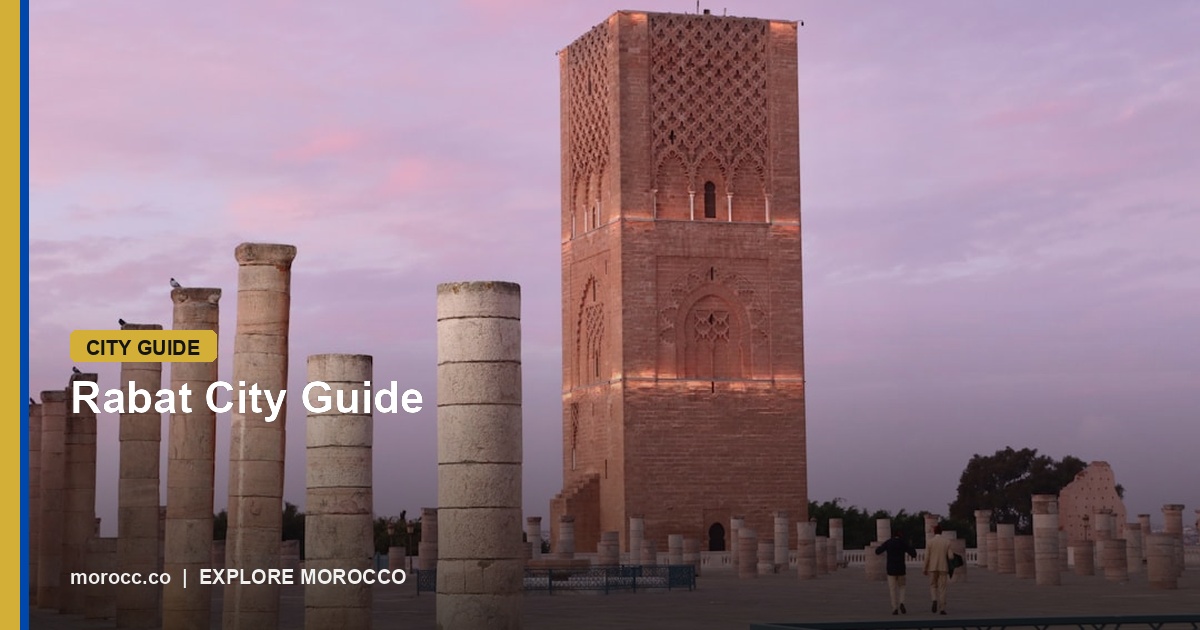
| 3. The Hassan Tower & Unfinished Mosque | Designed to be the second-largest mosque in the medieval Islamic world [18]. Measuring 183 x 139 meters, planned to hold over 20,000 worshippers simultaneously. Massive 44-meter sandstone minaret (planned for 86 m) with interior ramps for horse-riding muezzins. 348 circular stone columns survived the 1755 Lisbon Earthquake [18]. |
With the sudden death of Yaqub al-Mansur in 1199, construction ceased. For the next four centuries, Rabat shrank into a sleepy settlement huddled within the massive Almohad walls, while the imperial court relocated to Marrakech and Fes [1], [3].
The 17th Century: The Republic of Bou Regreg and the Barbary Corsairs
In the early 17th century, Rabat underwent an extraordinary economic, demographic, and political revival driven by the expulsion of Muslims from Spain [1], [18].
The Arrival of the Andalusian Moriscos
Between 1609 and 1614, King Philip III of Spain expelled hundreds of thousands of converted Muslims (Moriscos). Approximately 3,000 wealthy, Spanish-speaking Hornacheros (from Extremadura) and Andalusian refugees settled in Rabat (then called Salé-la-Neuve / "New Salé") [1], [12]:
- The Andalusian Wall: They constructed a defensive wall dividing the Almohad enclosure to protect the southern perimeter of the residential medina [14].
- Urban Architecture: They introduced distinctive white-and-blue whitewashed houses, terracotta-tiled roofs, and wrought-iron window grilles, visible today in the Kasbah and Rue des Consuls [14], [25].
The Corsair Republic (1627–1666)
In 1627, the Hornacheros and Andalusian exiles broke away from the weak Saadian sultanate and formed an independent maritime city-state known as the Republic of Bou Regreg (or Republic of Salé) [1]:
- Democratic Governance: Governed by a Diwan (council) and an elected Grand Admiral, it operated as a sovereign corsair oligarchy [1].
- Global Privateering: Corsair captains (such as the Dutch renegade Jan Janszoon / Murad Reis) sailed fast armed caravels from the Bou Regreg, raiding commercial shipping as far north as Plymouth, the English Channel, and Iceland to capture booty and European captives [1].
- European Diplomacy: European maritime powers (England, the Netherlands, France) signed formal commercial treaties and established consulates along Rabat's Rue des Consuls [1], [25].
In 1666, the founder of the Alaouite Dynasty, Sultan Moulay Rashid, seized Rabat and Salé, ending the corsair republic and permanently integrating the estuary into the Moroccan Sultanate.
20th-Century Transformation: Capital Status and the French Ville Nouvelle
Following the establishment of the French Protectorate in 1912, French Resident-General Louis-Hubert Lyautey made the monumental decision to move Morocco's administrative and political capital from inland Fez to Rabat on the Atlantic coast [1], [3], [6].
Henri Prost’s Garden City Urbanism
Lyautey commissioned renowned French architect and urban planner Henri Prost to design Rabat as a modern administrative metropolis [11]:
- Preservation of the Historic Core: Prost strictly preserved the Almohad walls, Kasbah, and medina without demolition, establishing a green protective buffer zone around the ancient city [11], [14].
- The Ville Nouvelle & Arabe Moderne Architecture: South of the historic core, Prost laid out expansive tree-lined boulevards (such as Avenue Mohammed V) flanked by buildings designed in the Neo-Mauresque (Arabe Moderne) style—marrying French Beaux-Arts proportions with traditional Moroccan horse-shoe arches, carved plaster, and cedar eaves [11].
- Public Green Spaces: Rabat was developed as a "Garden City" with sweeping public parks, including the Jardin d'Essais Botaniques, Nouzhat Hassan Park, and the Belvedere Gardens [11].
UNESCO World Heritage Inscription (2012)
In 2012, UNESCO inscribed Rabat on the World Heritage List under the title: "Rabat, Modern Capital and Historic City: a Shared Heritage" [2], [5], [11], [21], [23].
UNESCO World Heritage Components in Rabat (Inscribed 2012)
| Component | Significance |
|---|---|
| 1. The Historic Ville Nouvelle (1912–1930s) | One of the largest and most ambitious modern urban planning projects in 20th-century Africa [11]. |
| 2. The Kasbah of the Udayas (12th C.) | Preserved Almohad fortress, monumental gateway, and Andalusian residential quarter [14]. |
| 3. The Hassan Mosque & Minaret (1195–1199) | Landmark Almohad imperial architecture and surviving forest of stone pillars [18]. |
| 4. The Chellah Necropolis & Ancient Sala Colonia | Layered Roman forum, basilica, and Marinid royal tombs [13], [15]. |
| 5. The Almohad Ramparts & Historic Gates | Bab er-Rouah, Bab Zaer, Bab el-Hadd, and 5 km of 12th-century city fortifications [26]. |
| 6. The 17th-Century Medina & Andalusian Wall | Living urban residential quarter, craft souks, and Morisco architecture [14], [25]. |
| 7. The Habous Quarter of Diour Jamaâ & Jardin d'Essais Botaniques | Harmonious modern extensions and historic national botanical trial gardens. |
The Mausoleum of Mohammed V
Erected on the esplanade of the Hassan Tower between 1961 and 1971, the Mausoleum of Mohammed V represents the pinnacle of modern Moroccan craftsmanship. Designed by Vietnamese architect Eric Vo Toan, the white Italian marble tomb contains the sarcophagi of King Mohammed V and his sons King Hassan II and Prince Moulay Abdallah, adorned with hand-carved cedar ceilings, gilded brass lanterns, and intricate zellij mosaics [13], [18], [25].
National Museums & Cultural Repositories
Rabat is the intellectual and museological capital of Morocco, home to premier national cultural institutions [4], [20].
- Museum of History and Civilizations (Musée de l'Histoire et des Civilisations): Founded in 1932 as the Archaeological Museum, it houses Morocco's finest collection of archaeological antiquities, including the world-famous bronze portrait busts of King Juba II and Roman statesmen excavated at Volubilis [4], [7], [20], [22], [27].
- Mohammed VI Museum of Modern and Contemporary Art (MMVI): Opened in 2014, the first national museum dedicated to modern Moroccan and international fine arts.
- Grand Theatre of Rabat: Designed by legendary architect Zaha Hadid on the banks of the Bou Regreg, this 1,800-seat futuristic cultural landmark anchors the 21st-century Bou Regreg valley regeneration.
Comparative Matrix: Rabat vs. Morocco's Imperial Capitals
| Dimension | Rabat | Fes | Marrakech | Meknes |
|---|---|---|---|---|
| Primary Status | Political Capital & Seat of Royal Government [6], [24] | Spiritual & Academic Capital | Tourism & Cultural Capital | Agricultural & Historical Capital |
| Founding Dynasty | Almohad Caliphate (1150 CE) [1], [3] | Idrisid Dynasty (789 CE) | Almoravid Dynasty (1062 CE) | Almoravid/Alaouite (1061 / 1672) |
| UNESCO Designation | "Modern Capital & Historic City" (2012) [2], [11] | Medina of Fez (1981) | Medina of Marrakesh (1985) | Historic City of Meknes (1996) |
| Urban Fabric | Synthesis of Almohad monuments & French garden city | Dense car-free medieval urban labyrinth | Extensive mudbrick ramparts, palm groves, souks | Monumental Alaouite imperial palace complex |
| Maritime Connection | Atlantic Ocean & Bou Regreg River Port [1], [6] | Inland river valley (Oued Fes) | Inland Haouz alluvial plain | Inland Saïss fertile agricultural plain |
Detailed Chronological Timeline
Frequently Asked Questions (FAQ)
1. Why was Rabat chosen as Morocco’s capital city?
In 1912, French Resident-General Louis-Hubert Lyautey selected Rabat over historic inland capitals like Fez and Marrakech due to its strategic coastal location, moderate climate, defensible position on the Atlantic, and lack of political factionalism [1], [3], [6]. Following independence in 1956, King Mohammed V confirmed Rabat as the permanent capital of the Kingdom of Morocco [1], [24].
2. What is the meaning of the name "Rabat"?
The name originates from the Arabic word ribāt (رباط), meaning a "fortified military monastery" or "frontier camp" [3], [12]. In the 12th century, Caliph Yaqub al-Mansur named the expanded imperial city Ribat al-Fath ("Camp of Victory") following the Almohad victory at the Battle of Alarcos [1], [3].
3. What is the Hassan Tower and why is it unfinished?
The Hassan Tower is the 44-meter minaret of an immense mosque commissioned in 1195 by Almohad Caliph Yaqub al-Mansur, designed to be the largest mosque in the western Islamic world [18]. When the Caliph died in 1199, construction halted abruptly, leaving the sandstone tower at half its intended 86-meter height and the surrounding courtyard with 348 stone columns [18].
4. What was the Republic of Bou Regreg (Republic of Salé)?
The Republic of Bou Regreg (1627–1666) was an autonomous corsair republic formed in Rabat and Salé by Andalusian Muslim refugees (Hornacheros) expelled from Spain [1], [18]. Operating as an independent naval democracy, its corsair fleet raided maritime shipping across the Atlantic Ocean and Mediterranean Sea [1].
5. What makes Rabat's UNESCO World Heritage status unique?
Inscribed in 2012, Rabat's UNESCO listing recognizes a "Shared Heritage" representing the harmonious urban synthesis between ancient Roman ruins (Sala Colonia), medieval Arab-Muslim architecture (Almohad ramparts, Kasbah, Hassan Tower), 17th-century Andalusian quarters, and early 20th-century French colonial garden-city urban planning (Ville Nouvelle) [2], [11], [21].
Continue Exploring
Nearby city guides
- Casablanca City Guide — Morocco's biggest city and economic engine, an hour southwest down the same Atlantic rail corridor.
- Kenitra City Guide — the region's other chief city 40 minutes north by train, its namesake in the Rabat-Salé-Kénitra region.
- Meknes City Guide — the most intimate of the four imperial capitals, an easy rail trip east for comparison with Rabat's Almohad monuments.
Practical guides for this trip
- ONCF Train & Al-Boraq High-Speed Railway Guide — Rabat is a flagship stop on the Al-Boraq high-speed line; timetables, stations, and tickets explained.
- Self-Guided Medina Visual Walking Maps — visual walking routes for the Udayas Kasbah lanes and the Andalusian medina's Rue des Consuls.
- Moroccan Mint Tea & Café Culture Guide — how to order, sip, and linger like a local on the Ville Nouvelle's boulevard terraces.
References and Citations Index
- [[1]] Wikipedia: Rabat — Comprehensive historical overview of Almohad foundation, 17th-century Barbary corsairs, and modern national capital status.
- [[2]] UNESCO World Heritage Centre: Rabat, Modern Capital and Historic City — Official UNESCO World Heritage inscription dossier and 2023 heritage safeguarding agreements.
- [[3]] Encyclopædia Britannica: Rabat - Capital City and Attractions — Analysis of 12th-century foundation by Abd al-Mu'min as a ribat, Almohad urbanism, and capital functions.
- [[4]] Museum With No Frontiers (MWNF): Rabat Archaeological Museum — Directory and collection summary of the Museum of History and Civilizations in Rabat.
- [[5]] Journey Beyond Travel: Rabat UNESCO World Heritage Series — Cultural and architectural travel exploration of Rabat’s UNESCO landmarks.
- [[6]] Encyclopædia Britannica: Morocco Overview & Capital — Geographical and political profile highlighting Rabat's Atlantic coastal location and port network.
- [[7]] Tripadvisor: National Archaeology Museum Reviews — Visitor information detailing prehistoric and Roman collections open since 1986.
- [[8]] UNESCO Field Office in Rabat — Institutional overview of UNESCO’s Maghreb regional headquarters established in Rabat in 1991.
- [[9]] Encyclopædia Britannica: Etymology of Rabat — Semitic linguistic analysis of the word ribat denoting a fortified town, camp, or monastery.
- [[10]] Moroccan National Tourism Office (MNTO): Official Portal — National tourism guide covering capital cultural attractions and heritage circuits.
- [[11]] Africa24 TV: Rabat - UNESCO Heritage and Green Metropolis — Documentary feature on the 2012 UNESCO inscription, Arab-Muslim heritage, and 20th-century garden city planning.
- [[12]] Britannica Kids: Rabat History and Salé Twin-City Dynamics — Educational overview of 12th-century fortress foundation and interconnected ties with Salé.
- [[13]] Visit Morocco: Chellah Archaeological Site and Roman Heritage — Video profile exploring Roman Sala Colonia, Marinid royal tombs, and botanical gardens.
- [[14]] Morocco Go Now: Kasbah of the Udayas and Rabat Medina — Architectural showcase of the 12th-century cliff-top Kasbah, Andalusian quarter, and medina.
- [[15]] GetYourGuide: Chellah Archaeological Tours — Archaeological tour guide detailing 2,000 years of Roman and Islamic history at the gates of Rabat.
- [[16]] Encyclopædia Britannica: History of Morocco - Major Cities — Synthesis of Moroccan kingdom history, dynasties, and metropolitan centers.
- [[17]] YouTube: Rabat Archaeological Museum Overview — Video exploration of the Museum of History and Civilizations.
- [[18]] GetYourGuide: UNESCO Sites in Rabat - Hassan Tower & Udayas — Historical guide to the iconic Hassan Tower minaret, Almohad columns, and 17th-century quarters.
- [[19]] EBSCO Research Starters: Rabat Geography, Phoenicians & Roman Era — Academic summary of Phoenician trading posts, Carthaginian settlement, and 40 CE Roman Sala Colonia.
- [[20]] Wikipedia: Museum of History and Civilizations — Institutional profile of Morocco's national archaeological museum founded in 1932.
- [[21]] Wanderlust Magazine: Morocco's 9 UNESCO World Heritage Sites — Comparative guide analyzing Rabat alongside Morocco’s eight other UNESCO World Heritage properties.
- [[22]] Story Rabat: Museum of History and Civilizations Collections — Cultural analysis of prehistoric artifacts, Roman bronze sculptures from Volubilis, and Islamic arts.
- [[23]] Not Just A Tourist: Complete Guide to Morocco's UNESCO Heritage — In-depth review of Rabat's 2012 inscription criteria and modern-heritage synthesis.
- [[24]] Encyclopædia Britannica: Summary of Morocco — National overview confirming Rabat as the official capital and administrative seat.
- [[25]] Memphis Tours: Rabat Essential Experiences & Royal Monuments — Travel guide to ancient fortifications, the Mausoleum of Mohammed V, and hidden Andalusian gardens.
- [[26]] Encyclopædia Britannica: Rabat Monumental Gates and Almohad Architecture — Architectural analysis of 12th-century Almohad defensive gates and monumental stonework.
- [[27]] Maroc.ma: From Archaeological Museum to Museum of History and Civilizations — State portal documenting national museological modernization and heritage curation.
Last reviewed: 2026-10-10 by morocc.co editorial team.