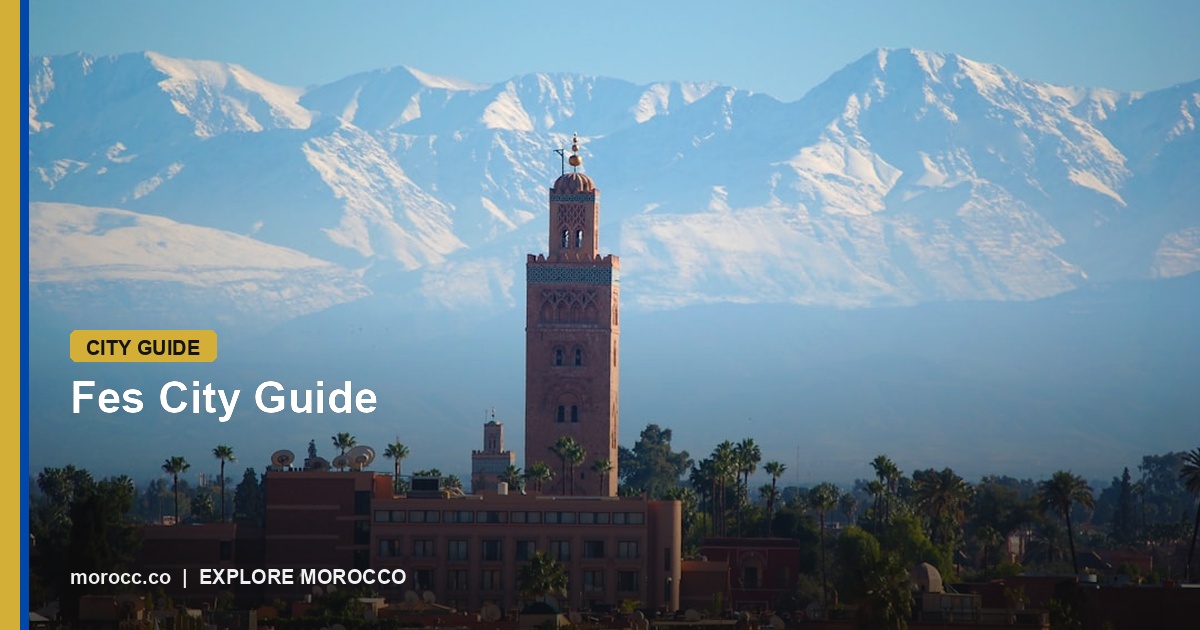
 City guide
Morocco
Fes City Guide
Direct Answer: Fes is Morocco's oldest imperial capital and the world's most intact medieval Islamic city — a living, 1,200-year-old medina of more than 9,400 alleyways that still hums with...
Direct Answer: Fes is Morocco's oldest imperial capital and the world's most intact medieval Islamic city — a living, 1,200-year-old medina of more than 9,400 alleyways that still hums with ancient craft guilds, and home to Al Quaraouiyine (859 CE), the oldest continually operating university on Earth.
Executive Overview & Key Takeaways
- Oldest Imperial City of Morocco: Founded in 789 CE on the banks of the Wadi Fes (Jawhar River) by Idris I and expanded in 807–808 CE by his son Idris II, Fes stands as Morocco's oldest imperial capital and the political birthplace of the first unified Moroccan Islamic state [1], [2], [3], [8], [24], [29].
- Home of the World’s Oldest University: Established in 859 CE by Fatima al-Fihri, the University of Al Quaraouiyine is recognized by UNESCO and global historians as the oldest continually operating institution of higher learning in the world, establishing Fes as the spiritual and intellectual capital of the Maghreb [4], [16].
- The Marinid Golden Age (13th–14th Centuries): Under the Marinid Sultanate, Fes replaced Marrakech as the imperial capital, sparking a monumental renaissance of Moorish architecture, royal administrative citadels (Fes el-Jdid), and masterpiece madrasas such as Al-Attarine and Bou Inania [1], [4], [23].
- Morocco’s First UNESCO World Heritage Site (1981): Inscribed at the 5th session of the World Heritage Committee, Fes el-Bali was Morocco's very first UNESCO listing, celebrated as the world's most intact medieval Islamic city and the largest contiguous car-free urban zone on Earth [1], [10], [22], [25].
- Living Medieval Craft Guilds: Preserving ancient guild systems, Fes continues to operate the 11th-century Chouara Tannery, world-famous master zellij ceramic studios, brass-engraving souks, and traditional textile weavers [12], [18], [27].
Fast Facts: Fes & The Medina of Fes el-Bali
| Attribute | Detail | Citations |
|---|---|---|
| Official Name | Fes / Fez (فاس / ⴼⴰⵙ) | [1], [3], [15] |
| Administrative Role | Capital of Fes-Meknes Region; Second-largest city in Morocco (1.256M pop., 2024 census) | [3], [15] |
| Founders & Dates | Idris I (East Bank, 789 CE) & Idris II (West Bank, 807–808 CE) | [2], [3], [8], [29] |
| Imperial Status | Oldest of Morocco's four Imperial Cities (Fes, Marrakech, Meknes, Rabat) | [3], [24] |
| World Record Landmark | University of Al Quaraouiyine (Founded 859 CE by Fatima al-Fihri) | [4], [16] |
| Golden Age Dynasty | The Marinids (1244–1465), builders of Fes el-Jdid and royal madrasas | [1], [4], [23] |
| UNESCO Inscription | Inscribed in 1981 as Medina of Fez (Morocco's 1st inscribed site, Criteria ii, v) | [1], [10], [22] |
| Urban Morphology | Over 9,400 alleyways, 300+ districts, 100% pedestrian/pack-animal transit | [18], [25] |
| Iconic Symbols | Blue ceramic Zellij, Chouara Tannery vats, Fez Tarboosh felt hat, Bab Bou Jeloud | [6], [16], [18] |
Historical Chronology of Fes
The history of Fes is synonymous with the historical trajectory of Islamic civilization in the western Maghreb [2], [13], [14]. Established during the initial wave of independent Islamic statehood in North Africa, Fes grew into a trans-Mediterranean center of theology, jurisprudence, astronomy, mathematics, and artisanal craftsmanship [4], [16], [20].
The Tripartite Urban Divisions of Fes
| Urban Sector | Epoch Founded | Distinctive Heritage Features |
|---|---|---|
| Fes el-Bali (Old Fes) | 789–808 CE (Idrisid Dynasty) | Ancient core, 9,400 alleys, Al Quaraouiyine, Chouara Tannery |
| Fes el-Jdid (New Fes) | 1276 CE (Marinid Dynasty) | Marinid royal citadel, Dar al-Makhzen Palace, Mellah |
| Ville Nouvelle (Modern City) | 1916 CE (Protectorate) | French colonial grid boulevards, commercial center, rail links |
Foundation Under the Idrisid Dynasty (789–921 CE)
Idris I and the Flight from the Abbasids
In 786 CE, Idris ibn Abdallah (a great-grandson of the Prophet Muhammad's grandson Hassan) fled the Arabian Peninsula following the Battle of Fakhkh near Mecca [8], [20]. Reaching Morocco, he was embraced by the Amazigh Awraba tribe near Roman Volubilis (Walili), who proclaimed him their spiritual and political leader in 789 CE, founding the Idrisid Dynasty [3], [8], [17].
Seeking a defensible, water-abundant capital, Idris I selected the fertile alluvial basin of the Wadi Fes (also termed the Jawhar River) in 789 CE to establish a fortified settlement on the eastern bank [3], [5], [24].
Idris II and the Dual Bank Metropolis
Following the assassination of Idris I, his son Idris II expanded the foundation in 807–808 CE, establishing a separate walled settlement on the western bank of the river [2], [24], [29]. The twin settlements received two monumental waves of skilled refugee immigration that permanently defined the city's cosmopolitan character [2], [14]:
- The Andalusian Quarter (Adwat al-Andalus): Settled in 818 CE by over 8,000 Muslim families fleeing persecution following an uprising in Córdoba, Al-Andalus. They erected the monumental Andalusian Mosque [2], [14].
- The Kairouan Quarter (Adwat al-Qarawiyyin): Settled in 825 CE by hundreds of affluent families fleeing unrest in Kairouan (modern Tunisia), bringing sophisticated urban culture, commerce, and scholarly traditions [2], [16].
Al Quaraouiyine: The World's Oldest Operating University
In 859 CE, Fatima al-Fihri, an educated and wealthy daughter of a Kairouan merchant, dedicated her entire inherited fortune to construct a spiritual and academic complex for her community: the Mosque and University of Al Quaraouiyine (Jâmi’at al-Qarawiyyîn) [4], [16].
Academic and Intellectual Primacy
Al Quaraouiyine rapidly evolved into the preeminent intellectual center of the Islamic world and the Mediterranean basin [4], [16], recognized by UNESCO as the oldest continually operating degree-granting university in the world [4], [16]:
- Pioneering Academic Disciplines: The institution offered comprehensive curricula spanning Islamic theology, jurisprudence (Fiqh), classical Arabic grammar, astronomy, mathematics, medicine, logic, and cartography [4], [28].
- World-Renowned Scholars: Over the centuries, Al Quaraouiyine drew and educated illustrious figures including:
- Ibn Khaldun (historian and father of modern sociology)
- Leo Africanus (famed diplomat and geographer)
- Ibn Rushd (Averroës, philosopher)
- Gerbert of Aurillac (who studied Arabic mathematics and later became Pope Sylvester II, introducing Arabic numerals to Europe)
- Moses Maimonides (renowned Jewish philosopher and physician who lived and taught nearby) [4], [16], [28].
The Marinid Golden Age (13th–14th Centuries)
The zenith of Fes occurred under the Marinid Sultanate (1244–1465), who transferred the capital of Morocco from Marrakech back to Fes [1], [4].
Creation of Fes el-Jdid (1276 CE)
To house the royal court, elite garrisons, administrative bureaus, and foreign embassies separate from the congested alleys of Fes el-Bali, Sultan Abu Yusuf Ya'qub founded Fes el-Jdid ("New Fes") in 1276 CE [1], [15]:
- Dar al-Makhzen: The monumental 80-hectare Royal Palace complex, famous for its magnificent seven brass gates and hand-carved cedar portals [1], [15].
- The Royal Mellah: Established adjacent to the palace in the 14th century, this became Morocco's very first designated Jewish quarter (Mellah), whose balconies, wrought-iron craftsmanship, and gold jewelry workshops formed a vibrant community [1], [15].
Masterpiece Marinid Madrasas
To promote state-sponsored Maliki jurisprudence and educate royal administrators, Marinid sultans ringed Al Quaraouiyine with magnificent residential colleges (madrasas) [1], [23]:
- Al-Attarine Madrasa (1323–1325 CE): Commissioned by Sultan Abu Sa'id Uthman II, this compact jewel features intricate hand-chiseled stucco, geometric zellij polychrome tiles, and carved Atlas cedar calligraphy [23].
- Bou Inania Madrasa (1351–1356 CE): Built by Sultan Abu Inan Faris, it is the only madrasa in Fes with a full congregational minaret and an elaborate hydraulic water clock (Dar al-Magana) [1], [23].
Urban Anatomy: Fes el-Bali as a Living Medieval Masterpiece
Urban Systems of the Medina of Fes
| Urban System | Function & Features |
|---|---|
| 9,400 Alleys | Completely car-free; pedestrian corridors navigated by foot and pack donkeys (Balak!) [18], [25]. |
| Water Network (Qanawat) | Ancient Oued Fes hydraulic system distributing fresh water to hundreds of public fountains, hammams, and mosques [3], [5]. |
| Guild Quarters | Functional zonation: clean crafts (perfumes, silk) near mosques; tanneries and potters on periphery. |
| Monumental Gates (Abwab) | Fortified access via Bab Bou Jeloud (The Blue Gate), Bab Guissa, Bab Ftouh, and Bab Rcif [15], [19]. |
Fes el-Bali remains one of the densest and most intact medieval urban fabrics on Earth — a maze best navigated with the self-guided medina walking maps in hand [1], [18].
The Chouara Tannery (11th Century)
Dating back over a thousand years, the Chouara Tannery is an iconic symbol of Fes's living artisanal continuity [18], [27]:
- Centuries-Old Chemical Process: Cow, goat, sheep, and camel hides are soaked in stone vats containing pigeon droppings (rich in ammonia to soften leather) and limestone solutions [18].
- Natural Mineral & Plant Dyes: Tanners stomp hides bare-legged in circular vats dyed with natural pigments: saffron and turmeric for yellow, poppy for red, cedarwood for brown, indigo for blue, and mint for green [18], [27].
The Fez Tarboosh Hat
The city gave its name to the iconic Fez (also known as the Tarboosh), the brimless cylindrical red felt hat adorned with a black silk tassel [6]. Manufactured in the specialized souks of Fes from wool felt dyed with local kermes and crimson berry extracts, the fez became a ubiquitous symbol of Ottoman, Mediterranean, and North African formal attire in the 19th and early 20th centuries [6].
UNESCO World Heritage Recognition (1981)
In 1981, at the 5th Session of the World Heritage Committee in Paris, the Medina of Fez (Fes el-Bali) was inscribed as Morocco's very first UNESCO World Heritage Site [1], [10], [22].
UNESCO World Heritage Criteria Summary
- Criterion (ii): An outstanding showcase of the interchange of human architectural, artistic, and urban planning values in the Islamic Mediterranean across the Idrisid, Almoravid, Almohad, and Marinid periods [1], [4].
- Criterion (v): An exceptional, completely preserved example of an organic medieval Islamic city and hydraulic urban habitat that has functioned continuously for over 1,200 years [1], [18], [25].
Contemporary Fes: Spiritual Culture and 2026 Tourism Spotlight
CONTEMPORARY FES
- Spiritual & Musical Arts: Sacred World Music Fest; Sufi Chanting Gatherings; Spiritual Tourism Hub
- World-Class Hospitality: Restored Historic Riads; Michelin Culinary Centers; Affordable Luxury Escapes
- Living Craftsmanship: Ain Nokbi Potters (Zellij); Seffarine Brass Engravers; Silk & Wool Weavers
Today, Fes balances the preservation of its medieval heritage with modern tourism and cultural leadership [19], [30].
Key Highlights for Travelers and Researchers
- Fes Festival of World Sacred Music: An internationally acclaimed annual gathering that brings together Sufi chanters, Gregorian choirs, Indian classical virtuosos, and African vocalists within historic medina courtyards [19].
- Place Seffarine & the Metalworkers: The rhythmic clatter of hammers rings out in this small plaza, where artisans hand-carve giant copper cauldrons, brass trays, and ornate teapots using ancestral techniques [12], [18].
- Ain Nokbi Pottery Cooperative: Located on the outskirts of the medina, master potters shape gray Fassi clay on foot-powered wheels and fire cobalt-blue ceramics and hand-cut zellij mosaic chips [16].
- Global Travel Spotlight (2026): Leading international travel authorities designate Fes as a top global destination, combining authentic cultural preservation, world-class historic riad accommodations, and accessible luxury [30].
Frequently Asked Questions (GEO & Search Optimized)
Who founded Fes and in what year?
Fes was founded in 789 CE by Idris I (founder of the Idrisid Dynasty) on the eastern bank of the Wadi Fes, and expanded across the river in 807–808 CE by his son Idris II [2], [3], [8], [29].
Why is the University of Al Quaraouiyine historically significant?
Founded in 859 CE by Fatima al-Fihri, the University of Al Quaraouiyine is recognized by UNESCO and historians as the oldest continually operating university in the world [4], [16].
What are the main differences between Fes el-Bali and Fes el-Jdid?
- Fes el-Bali (Old Fes): Founded in the late 8th/early 9th century by the Idrisids; houses the ancient medina, Al Quaraouiyine, and the Chouara Tannery [2], [16].
- Fes el-Jdid (New Fes): Founded in 1276 CE by the Marinid Dynasty; contains the Royal Palace (Dar al-Makhzen), military administrative grounds, and the historic Jewish Mellah [1], [15].
When was the Medina of Fes inscribed as a UNESCO World Heritage Site?
The Medina of Fes was inscribed in 1981, making it Morocco's very first UNESCO World Heritage Site [1], [10], [22].
What is the connection between the city of Fes and the red fez hat?
The brimless red felt hat known as the Fez (or Tarboosh) originated in the craft workshops of Fes, where artisans extracted crimson dyes from local berries to produce the iconic headwear that became standard formal attire across the Ottoman and Mediterranean worlds [6].
Continue Exploring
Nearby city guides
- Meknes City Guide — Fes's sister imperial capital in the same Fes-Meknes region, about an hour west by road or rail.
- Chefchaouen City Guide — the blue-washed Rif mountain town, roughly two hours north of Fes.
- Moulay Idriss Zerhoun City Guide — the hilltop shrine town where Idris I, Fes's founder, is buried, beside the Roman ruins of Volubilis.
Practical guides for this trip
- Footwear: The Medina Walking Field Guide — 9,400 alleyways of pack-donkey traffic punish the wrong shoes.
- Souk Bargaining & Price Negotiation Masterclass — Fes's guild souks are Morocco's craft heartland; learn the etiquette before you haggle.
- Airport-to-Medina Arrival Guides (FEZ) — step-by-step arrival logistics for flying into Fes and reaching the medina.
Complete Citation & Sources Index
[1] UNESCO World Heritage Centre. Medina of Fez - Official World Heritage Listing & Inscription Criteria.
Available at: https://whc.unesco.org/en/list/170/
[2] Wikipedia. History of Fez: Idrisid Foundation, Andalusian-Kairouan Migration, and Dynastic Rule.
Available at: https://en.wikipedia.org/wiki/History_of_Fez
[3] Encyclopaedia Britannica. Fes | Morocco, Map, & Facts: Oldest of the Four Imperial Cities.
Available at: https://www.britannica.com/place/Fes
[4] UNESCO Multimedia Archives. Medina of Fez: Home to the Oldest University in the World.
Available at: https://www.unesco.org/archives/multimedia/document-1203
[5] Archaeology and Civilizations Group. History of Fez: Idris I Foundation on the Jawhar / Wadi Fes River.
Available at: https://www.facebook.com/groups/archeologyandcivilizations/posts/4485660601527429/
[6] Encyclopaedia Britannica. Fez (Hat): Brimless Cylindrical Red Felt Headwear.
Available at: https://www.britannica.com/topic/fez
[7] UNESCO World Heritage Centre. State of Conservation of World Heritage Properties in Morocco.
Available at: https://whc.unesco.org/en/statesparties/ma/
[8] Encyclopaedia Britannica. Idrisid Dynasty: Arab Muslim Dynasty in Morocco (789–921).
Available at: https://www.britannica.com/topic/Idrisid-dynasty
[9] Encyclopaedia Britannica. Morocco: French Protectorate (1912–1956) and Monarchy Overview.
Available at: https://www.britannica.com/place/Morocco
[10] WorldAtlas. UNESCO World Heritage Sites in Morocco: Fes el Bali Inscribed in 1981.
Available at: https://www.worldatlas.com/articles/unesco-world-heritage-sites-in-morocco.html
[11] Travel Art Way. Morocco Visit: History, Culture, Nature, Landscapes, Berbers, and Fez.
Available at: https://travelartway.com/morocco-visit-history-culture-nature-landscapes-berbers-fez-fes/
[12] Morocco Go Now. Fez: A Timeless City Where History and Living Culture Come Alive.
Available at: https://www.facebook.com/moroccogonow/videos/fez-a-timeless-city-where-history-and-culture-come-alive-explore-ancient-streets/2182064385551250/
[13] Moroccan History Forum. The Medina of Fez and the Emergence of Moroccan Imperial Rule.
Available at: https://www.facebook.com/groups/286866152596429/posts/1386531965963170/
[14] Moroccan History Reels. The First Major Moroccan Islamic State: The Idrisid Dynasty.
Available at: https://www.instagram.com/reel/DYhryZUtHs4/
[15] Wikipedia. Fez, Morocco: Demographics, Geography, and 2024 Population Census.
Available at: https://en.wikipedia.org/wiki/Fez,_Morocco
[16] Morocco Official. Ultimate Guide to Moroccan UNESCO Sites: Fez el-Bali & Al Quaraouiyine.
Available at: https://moroccoofficial.com/ultimate-guide-moroccan-unesco-sites-2026/
[17] The History Files. Idrisid Dynasty (Kingdom of Fez) AD 788–974.
Available at: https://www.historyfiles.co.uk/KingListsAfrica/AfricaMorocco.htm
[18] BBC News Africa. Fes el-Bali: A Living Maze Where History, Learning, and Commerce Meet.
Available at: https://www.facebook.com/BBCnewsafrica/videos/tucked-away-in-northern-morocco-fes-el-bali-is-a-living-maze-where-history-learn/851427277593261/
[19] Journey Beyond Travel. Fez: UNESCO World Heritage Sites Series and Cultural Marvels.
Available at: https://www.journeybeyondtravel.com/blog/fez-unesco-world-heritage-sites-series.html
[20] The Story of Morocco Podcast. Morocco's Idrisid Dynasty and the Founding of Fez.
Available at: https://www.iheart.com/podcast/53-the-story-of-morocco-kingdo-331540353/episode/moroccos-idrisid-dynasty-the-founding-of-338217245/
[21] Encyclopaedia Britannica. Morocco Summary: Protectorate Era and Territorial Sovereignty.
Available at: https://www.britannica.com/summary/Morocco
[22] Wikipedia. List of World Heritage Sites in Morocco: Medina of Fez Inscribed 1981.
Available at: https://en.wikipedia.org/wiki/List_of_World_Heritage_Sites_in_Morocco
[23] Architectural Heritage Documentaries. The Al-Attarine Madrasa: Masterpiece of Marinid Intellectual Architecture in Fez.
Available at: https://www.facebook.com/essabrybasma1988/videos/during-the-marinid-dynasty-morocco-witnessed-a-remarkable-scientific-and-intelle/2564450827267532/
[24] Moroccan Journeys. The Imperial City of Fez: From Idris I to the Modern Era.
Available at: https://moroccanjourneys.com/the-imperial-city-of-fez-morocco/
[25] Travel and Tour World. The Astonishing Medina of Fes: Living Medieval Urbanism.
Available at: https://www.travelandtourworld.com/news/article/step-into-a-city-where-getting-lost-is-inevitable-and-history-closes-in-around-you-the-astonishing-medina-of-fes-morocco/
[26] Serenity Morocco Tours. Morocco History Guide: Idrisids and the Urban Evolution of Fes.
Available at: https://www.serenitymoroccotours.com/morocco-history-guide
[27] Encyclopaedia Britannica. Moroccan Craftsmanship and Traditional Dye Works Overview.
Available at: https://www.britannica.com/video/Overview-Marrakech-Morocco/-192068
[28] UNESCO World Heritage Centre. Scholarly Hubs and Intellectual Traditions of the Medieval World.
Available at: https://whc.unesco.org/en/newproperties/
[29] The Collector. Historic Fez: The Intellectual Capital of Morocco.
Available at: https://www.thecollector.com/historic-fez/
[30] Travel and Tour World. Fes Takes the Spotlight as a Top Global Destination for Cultural Luxury and Heritage.
Available at: https://www.travelandtourworld.com/news/article/morocco-fes-takes-the-spotlight-in-2026-as-a-must-visit-destination-combining-timeless-charm-affordable-luxury-and-authentic-moroccan-experiences/
Last reviewed: 2026-10-10 by morocc.co editorial team.