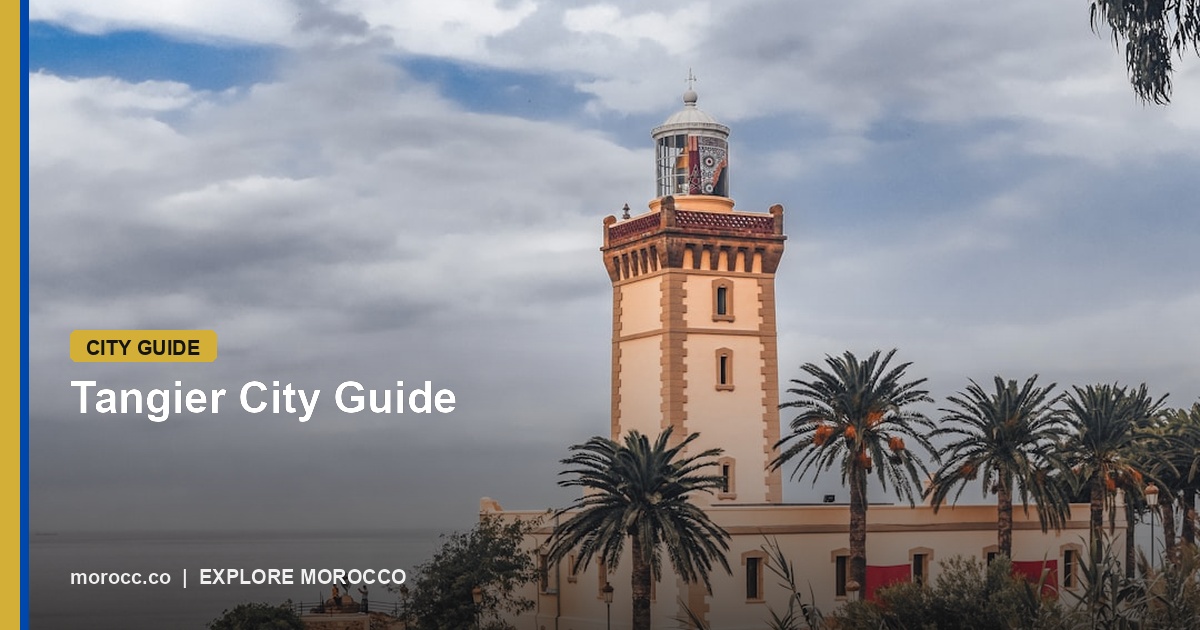
 City guide
Morocco
Tangier City Guide
Direct Answer: Tangier is Morocco's gateway city — a 3,000-year-old port on the Strait of Gibraltar that was a Phoenician trading post, the Roman capital of Mauretania Tingitana, the kingdom...
Direct Answer: Tangier is Morocco's gateway city — a 3,000-year-old port on the Strait of Gibraltar that was a Phoenician trading post, the Roman capital of Mauretania Tingitana, the kingdom's 19th-century diplomatic capital, and a self-governing International Zone from 1923 to 1956, before returning to Morocco as the country's booming second economic hub.
Quick Summary & Key Takeaways
Tangier briefing index
- Country and region: Kingdom of Morocco — Tanger-Tetouan-Al Hoceima region
- Coordinates: 35°46'36" N, 5°48'36" W — the Atlantic-Mediterranean nexus at the Strait of Gibraltar
- Strategic position: Northwestern tip of Africa, 14 km (8.7 mi) across the strait from Spain
- Elevation and climate: 0–145 m (0–475 ft) above sea level; Mediterranean oceanic climate
- Key historical epochs: Phoenician Tingis (before the 10th century BCE), Carthaginian port, Roman capital of Mauretania Tingitana, Islamic dynasties and corsair haven, Portuguese and English rule, 19th-century diplomatic capital of Morocco, the Tangier International Zone (1923–1956), modern economic metropolis
- Major cultural sites: Kasbah Museum of Mediterranean Cultures, Grand Socco and Petit Socco, Phoenician Tombs (Marshane), American Legation Museum, Cape Spartel, Caves of Hercules, Tanger-Med port complex
- Ancient Mediterranean Crossroads: Inhabited for over three millennia, Tangier (Tingis) originated before the 10th century BCE as an essential Phoenician trading factory, later developing into a major Carthaginian maritime emporium and the administrative capital of Roman Mauretania Tingitana [1], [4], [10], [16], [27].
- Diplomatic Capital of Morocco: In the 19th century, Moroccan Sultans designated Tangier as the official diplomatic capital of the Alaouite Empire, where foreign ambassadors, consulates, and international legations resided and negotiated [1], [7].
- The Tangier International Zone (1923–1956): Defined under the Tangier Statute of 1923, the city and its surrounding 382 km² (147 sq mi) territory operated as a unique, neutral, stateless international zone governed jointly by a multinational committee of European powers and the Mendoub (representing the Sultan) [2], [8], [11], [14], [17], [19].
- Cosmopolitan & Countercultural Haven: During the International Zone era and mid-20th century, Tangier's tax-free, multi-currency, and multinational legal framework attracted artists, writers, exiles, financiers, and espionage agents—becoming the epicenter for the Beat Generation (William S. Burroughs, Paul Bowles, Allen Ginsberg, Jack Kerouac) [5], [25], [28].
- Restoration of Moroccan Sovereignty (1956): Following the independence of Morocco and the historic 1947 speech of Sultan Mohammed V championing territorial unity, the multinational administration was dissolved in October 1956, fully restoring Tangier to Moroccan sovereignty [2], [22].
- Modern Renaissance & Tanger-Med Gateway: Today, Tangier is a booming economic powerhouse anchored by Tanger-Med (the largest container port on the Mediterranean and in Africa), the Al-Boraq high-speed rail line to Casablanca, and a burgeoning urban heritage revitalization [6], [9], [20], [26].
Fast Facts For Travelers
| Feature | Details & Specifications |
|---|---|
| Location & Coordinates | 35°46′36″ N, 5°48′36″ W; Northwest Morocco on the Strait of Gibraltar [1], [4] |
| Distance to Europe | 14 km (8.7 mi) across the Strait to the Spanish coastline [1], [7] |
| Ancient Foundations | Phoenician trading post before the 10th century BCE (Tingis) [4], [10], [16] |
| Roman Province Era | Annexed in 40 CE; Capital of Mauretania Tingitana for 5 centuries [16], [27] |
| 19th-Century Role | Diplomatic capital of the Moroccan Sultanate [1] |
| International Zone Era | 1923/1925 to October 1956 (382 km² multinational enclave) [2], [8], [17], [28] |
| Administering Powers | UK, France, Spain, Italy, Portugal, Belgium, Netherlands, Sweden, USA [8], [17], [25] |
| Sultan's Representative | The Mendoub, residing in the Mendoubia palace [19] |
| Key Museums | Kasbah Museum of Mediterranean Cultures (holds Larache artifacts) [20], [23] |
| High-Speed Transit | Al-Boraq TGV terminal connecting Tangier to Rabat and Casablanca [9] |
| Heritage Status | Ongoing UNESCO World Heritage urban heritage nomination project [6], [18], [26] |
Geographic & Strategic Orientation: Gateway of Two Seas
Tangier occupies one of the most vital geopolitical choke points on Earth: the northernmost tip of Morocco, commanding the entrance to the Strait of Gibraltar where the Atlantic Ocean meets the Mediterranean Sea [1], [4]. Only 14 kilometers of water separate the promontories of Tangier from the southern coast of the Iberian Peninsula (Spain) [1], [7].
Its natural deepwater bay, flanked by the rugged limestone cliffs of the Rif mountain foothills and the Atlantic promontory of Cape Spartel, has made Tangier a strategic military, naval, and merchant prize for every major Mediterranean empire from antiquity to the 21st century [1], [4], [24].
That same Rif range curling east along the Mediterranean coast eventually cradles Chefchaouen, the blue-washed mountain town — our Chefchaouen city guide covers it in depth for travelers combining the two.
Chronological Evolution of Tangier
Ancient Tangier: Phoenician, Carthaginian, and Roman Tingis
1. Phoenician Maritime Foundations (Pre-10th Century BCE)
Tangier's recorded urban history began over 3,000 years ago when Phoenician seafarers and merchants from the Levant (modern Lebanon) sailed beyond the Pillars of Hercules to establish commercial trading posts along the Atlantic and Mediterranean coasts of Morocco [4], [10], [13], [21].
Ancient Phoenician and Carthaginian Tingis
- Seaborne commercial base: export of purple dye (murex), Atlantic salted fish, garum, salted tuna, cedarwood, and metals
- Phoenician cliff tombs (Marshane): rock-cut burial chambers carved directly into the coastal sandstone above the Strait of Gibraltar
- Carthaginian naval depot: under Punic control, a heavily fortified stopover connecting Iberia to North Africa
The Phoenicians introduced their revolutionary alphabet, sophisticated metallurgy, and advanced navigation systems to the indigenous Amazigh populations of northern Morocco [4], [13], [24]. The rock-hewn Phoenician Tombs at Marshane, carved directly into the limestone cliffs above the Strait of Gibraltar, remain one of the city's most evocative archaeological sites [7], [21].
2. Roman Tingis and Mauretania Tingitana (40 CE – 5th Century CE)
Following the fall of Carthage in the Punic Wars, the region came under Roman influence through client Amazigh kingdoms. In 40 CE, Emperor Claudius annexed the Kingdom of Mauretania into the Roman Empire, dividing it into two provinces [16], [27].
Tangier was elevated to the status of a Roman colony (Colonia Julia Tingi) and served as the administrative and military capital of the western province: Mauretania Tingitana [16], [27].
The Roman province of Mauretania Tingitana
- Capital city: Tingis (Tangier) commanded the naval forces and regional customs administration of the Atlantic-Mediterranean corridor
- Southern anchor: Volubilis (Walili), the rich inland agricultural capital famed for olive oil, wheat, and marble monuments
- Five centuries of Roman rule: extensive aqueducts, basilicas, baths, and paved roads connecting Tingis with Lixus, Sala Colonia, and Volubilis
For over 500 years, Roman Tingis flourished as a cosmopolitan Mediterranean hub, linking the rich grain fields and olive groves of northern Morocco to the markets of Hispania (Spain) and Rome [16], [27].
Islamic Dynasties, European Fortifications, and Alaouite Restoration
In 707 CE, the Arab-Islamic expansion reached Tangier under the command of Musa ibn Nusayr, who appointed his Amazigh general, Tariq ibn Ziyad, as governor of the city [1]. In 711 CE, Tariq launched his historic crossing from Tangier across the Strait to the Rock that still bears his name (Jabal Tariq / Gibraltar), initiating the Islamic civilization of Al-Andalus.
Medieval dynasties and colonial interregnum
- Idrisid, Almoravid, and Almohad era: Tangier served as the primary naval launchpad and commercial bridge connecting Morocco to Al-Andalus
- Portuguese occupation (1471–1661): Portuguese forces captured the city, constructing sea ramparts, bastion towers, and the Upper Kasbah
- English rule (1661–1684): given to King Charles II of England as part of the dowry of Catherine of Braganza; defended by the English garrison
- Moulay Ismail's reconquest (1684): the Alaouite Sultan laid siege to the city, expelling the English and rebuilding the Kasbah, Grand Mosque, and fortifications under Moroccan Islamic governance
Tangier as Morocco's 19th-Century Diplomatic Capital
By the early 19th century, Moroccan Sultans made a strategic policy decision to keep foreign European ambassadors and diplomats confined to Tangier, preserving the imperial capitals of Fes and Marrakech from direct foreign political interference [1], [7].
19th-century diplomatic hub of Morocco
- Diplomatic enclaves: Britain, France, Spain, the United States, Russia, and Germany established historic consulates and legations in the medina
- The American Legation (1821): the first American public property outside the United States, gifted by Sultan Moulay Slimane, commemorating Morocco as the first country to recognize US independence in 1777
- Diplomatic precedent: Tangier became the negotiating forum for major international treaties, trade agreements, and maritime sanitary councils
This concentration of foreign embassies established Tangier’s unique legal and diplomatic culture, laying the direct institutional groundwork for its 20th-century internationalization [1], [8].
The Tangier International Zone (1923–1956)
The most extraordinary chapter in Tangier's modern history occurred between 1923 and 1956, when the city and its hinterland were detached from both the French and Spanish protectorates and transformed into a neutral, multinational enclave [2], [8], [11], [14].
Structure of the Tangier International Zone
- Governing treaty: Convention regarding the Organization of the Tangier Zone, signed 18 December 1923, implemented in 1925 [8], [17]
- Territory: 382 square kilometers (147 square miles) centered on Tangier [2]
- Administering powers: the United Kingdom, France, Spain, Italy, Portugal, Belgium, the Netherlands, Sweden, and the United States as an observing signatory [8], [17]
- Executive authority:
- The Committee of Control: consuls-general of the nine powers
- The Legislative Assembly: 26 members representing the foreign powers and the local Muslim and Jewish Moroccan communities
- The Mendoub: personal representative of the Moroccan Sultan, governing the indigenous Moroccan Muslim and Jewish population from the Mendoubia [19]
- Legal and financial status: free port, no income taxes, no currency controls, and multilingual Mixed Courts applying internationalized legal statutes [25], [28]
The Cosmopolitan Legend: Spies, Writers, and Bohemian Exiles
During its thirty-three years as an International Zone, Tangier became one of the most romanticized, cosmopolitan, and eccentric cities in the world [5], [25]:
The bohemian and espionage capital, 1923–1956
- Financial sanctuary: free banking laws and unregulated currency exchange turned Tangier into a haven for international capital, gold trading, and speculation [25], [28]
- Espionage crossroads: during World War II and the early Cold War, Allied and Axis intelligence agents operated openly in the cafés and riads
- Literary and artistic epicenter:
- Paul Bowles: author of The Sheltering Sky, resided in Tangier for 52 years, documenting traditional Moroccan music and literature
- The Beat Generation: William S. Burroughs wrote Naked Lunch here; joined by Allen Ginsberg, Jack Kerouac, and Tennessee Williams
- Visual artists: Henri Matisse painted iconic masterworks in the Kasbah; later joined by Francis Bacon and Eugene Delacroix
- Iconic café culture: intellectual debates at Café Hafa, Café de Paris, and Café Central in the Petit Socco [25]
Decolonization and Restoration to Moroccan Sovereignty
The existence of the International Zone was brought to an end by the rise of the Moroccan national liberation movement [2], [22]:
- The Historic Speech of Tangier (April 9, 1947): Sultan Mohammed V traveled to Tangier and delivered a momentous public address demanding complete independence, national sovereignty, and the geographic unity of Morocco across French, Spanish, and International zones.
- The Tangier Conference (October 1956): Following Morocco’s formal independence in early 1956, representatives of the administering powers met at the Fedala/Tangier Conference. On October 29, 1956, the Tangier Statute was formally abolished, and full sovereignty was returned to the Kingdom of Morocco [2], [22].
Cultural Landmarks and Urban Architecture
| Site / Monument | Historical Era / Function | Key Cultural Features |
|---|---|---|
| The Kasbah & Dar el-Makhzen Palace | 17th-century Sultan's palace / fortress | Houses the Kasbah Museum of Mediterranean Cultures [20] |
| Grand Socco & Mendoubia Gardens | Historic medina / urban market squares | Gateway between the ancient walled city and the Ville Nouvelle; century-old banyans |
| Petit Socco (Plaza Chinitas) | 19th–20th c. bohemian quarter / café center | Historic meeting place of diplomats, spies, and writers |
| American Legation | 1821 National Historic Landmark | Museum of US-Moroccan history; Paul Bowles library archives |
| Phoenician Tombs | Pre-10th c. BCE / Punic cliff necropolis | Rock-cut tombs on the Marshane cliff overlooking the Strait [21] |
| Caves of Hercules & Cape Spartel | Neolithic / mythological Atlantic promontory | Sea cave with an opening resembling the inverted map of Africa |
The Kasbah Museum of Mediterranean Cultures
Perched at the highest point of the medina within the former 17th-century palace of Sultan Moulay Ismail (Dar el-Makhzen), the Kasbah Museum exhibits an extraordinary collection of Moroccan antiquities [20]. The museum houses prominent Roman mosaics, Carthaginian funerary urns, and archaeological treasures relocated from the former Larache Archaeological Museum and the regional sites of Lixus and Cotta [20].
Modern Renaissance: Tanger-Med and 21st-Century Infrastructure
In the 21st century, Tangier has emerged as the industrial, logistics, and maritime powerhouse of North Africa [9], [26]:
Tangier's modern economic drivers
- Tanger-Med logistics mega-port: operating on the Strait of Gibraltar, the number-one container port in Africa and the Mediterranean basin, handling over 8 million TEUs annually and hosting global automotive hubs
- Al-Boraq high-speed railway: Africa's first high-speed train (TGV), linking Tangier to Rabat in 1h 20m and Casablanca in 2h 10m [9]
- Tangier City Port regeneration: conversion of the historic inner port into a world-class mega-yacht marina, cruise terminal, and corniche
- UNESCO urban heritage nomination: active initiatives to list Tangier's historic medina, Kasbah, and colonial architecture on the UNESCO World Heritage list [6], [18], [26]
Practical Visitor Guide & Travel Logistics
Tangier travel planner
- Best time to visit: April–June and September–November — mild Mediterranean temperatures, ideal for walking tours and coastal excursions
- Transportation and access:
- High-speed rail: Tangier-Ville station via Al-Boraq from Casablanca and Rabat
- International ferries: Tarifa–Tangier Ville (one-hour fast ferry) and Algeciras–Tanger Med
- Air travel: Tangier Ibn Battouta International Airport (TNG)
- Cultural highlights: sunset mint tea at legendary Café Hafa, the Kasbah promenade, American Legation exhibits, and fresh seafood by the port
- Nearby day trips: Asilah (whitewashed ramparts, 45 km south) and Tétouan (UNESCO-listed Andalusian medina, 60 km east) [15]
For those two excursions, our Asilah city guide and Tétouan city guide cover the Atlantic ramparts and the UNESCO-listed Andalusian medina in the same depth as this guide.
Pack for a city where Atlantic wind meets Mediterranean sun: the Ultimate Morocco Packing & Clothing Guide, Modest Dressing Decoded, and the Footwear & Medina Walking Field Guide cover exactly what to wear on the Kasbah's steep lanes and the seafront corniche. If you arrive by rail, the ONCF & Al-Boraq High-Speed Railway Guide explains tickets, the Tangier-Ville station layout, and onward connections.
Frequently Asked Questions (FAQ)
What was the Tangier International Zone?
The Tangier International Zone was a 382 km² (147 sq mi) neutral, multinational territory centered on the city of Tangier that existed from 1923/1925 until 1956. It was jointly administered by a committee of European powers alongside the Mendoub representing the Moroccan Sultan [2], [8], [11], [17].
Why did Tangier become the diplomatic capital of Morocco in the 19th century?
Moroccan Sultans designated Tangier as the sole official residence for foreign ambassadors and consuls in the 19th century to conduct foreign relations efficiently at the maritime border while keeping the inland imperial capitals (Fes and Marrakech) free from foreign political intrusion [1], [7].
What ancient civilizations ruled Tangier?
Tangier has been inhabited for over 3,000 years, sequentially influenced and ruled by the indigenous Amazigh, Phoenicians (who named it Tingis), Carthaginians, Romans (who made it the capital of Mauretania Tingitana), Vandals, Byzantines, and Arab-Islamic dynasties [1], [4], [16], [27].
Why is the American Legation in Tangier historically significant?
Gifted to the United States in 1821 by Sultan Moulay Slimane, the American Legation in Tangier is the oldest American diplomatic property in the world and the only US National Historic Landmark located outside the United States [7].
How does Tangier connect to the rest of Morocco today?
Tangier is connected to Rabat and Casablanca via Africa’s first high-speed railway line (Al-Boraq), which reaches speeds of 320 km/h, as well as a modern network of toll expressways (A1 and A4) [9].
Continue Exploring
Nearby city guides
- Asilah City Guide — whitewashed Atlantic ramparts 45 km south
- Tétouan City Guide — UNESCO-listed Andalusian medina 60 km east
- Chefchaouen City Guide — the blue town of the Rif mountains
Practical guides for this trip
- The Ultimate Morocco Packing & Clothing Guide
- Modest Dressing Decoded
- Footwear & Medina Walking Field Guide
- ONCF & Al-Boraq High-Speed Railway Guide
References and Citations Index
[[1]] Encyclopaedia Britannica. Tangier: History, Map, Population, and Facts. Historical overview spanning Phoenician, Carthaginian, Roman, Arab, and 19th-century diplomatic history.
URL: https://www.britannica.com/place/Tangier-Morocco
[[2]] Wikipedia. Tangier International Zone. Territory size (382 km²), legal structure, and existence from 1925 to 1956.
URL: https://en.wikipedia.org/wiki/Tangier_International_Zone
[[3]] GetYourGuide Heritage Services. Archaeological Museum, Tétouan: Regional Antiquities. Archaeological collections of northern Morocco.
URL: https://www.getyourguide.com/archaeological-museum-l176236/
[[4]] Wikipedia. Tangier. Overview of civilisations influencing Tangier from before the 10th century BCE and strategic Phoenician origins.
URL: https://en.wikipedia.org/wiki/Tangier
[[5]] Historical Documentary Series. Tangier: The City Once Owned By Everyone. European colonial empires and multinational administration of Tangier.
URL: https://www.youtube.com/watch?v=lJn9ziR6Zig
[[6]] UNESCO World Heritage Convention. Morocco State Party & Tangier Urban Heritage Workshop. World Heritage properties and Tangier urban nomination projects.
URL: https://whc.unesco.org/en/statesparties/ma/
[[7]] Dr. Dean Allen Historical Archives. Explorations: Tangier, Morocco. Ancient settlement history, Phoenician-Roman roots, and diplomatic enclaves.
URL: https://www.facebook.com/DrDeanAllenAuthor/posts/%F0%9D%90%84%F0%9D%90%B1%F0%9D%90%A9%F0%9D%90%A5%F0%9D%90%A8%F0%9D%90%AB%F0%9D%90%9A%F0%9D%90%AD%F0%9D%90%A2%F0%9D%90%A8%F0%9D%90%A7%F0%9D%90%AC-%F0%9D%9F%90%F0%9D%9F%91-%F0%9D%90%93%F0%9D%90%80%F0%9D%90%8D%F0%9D%90%86%F0%9D%90%88%F0%9D%90%84%F0%9D%90%91-%F0%9D%90%8C%F0%9D%90%8E%F0%9D%90%91%F0%9D%90%8E%F0%9D%90%82%F0%9D%90%82%F0%9D%90%8E-tangier-is-a-city-in-northern-morocco-with-a-pop/1671341664351918/
[[8]] Oxford Public International Law. Convention regarding the Organization of the Tangier Zone (18 December 1923). Legal statute between the UK, France, and Spain.
URL: https://opil.ouplaw.com/display/10.1093/law:epil/9780199231690/law-9780199231690-e1363
[[9]] Visit Morocco. Archaeological Treasures of Morocco: Rabat-Tangier Corridor. Archaeological context, UNESCO connectivity, and transportation.
URL: https://www.visitmorocco.com/en/discover-morocco/archaeological-treasures-morocco
[[10]] Mediterranean History Channel. The Phoenicians: Masters of the Ancient Mediterranean. Maritime navigation and Western Mediterranean trading posts 3,000 years ago.
URL: https://www.youtube.com/watch?v=dRAN_Ge6KV4
[[11]] KU Leuven Faculty of Law. The International Zone of Tangier (1923–1956): Multinational Governance. Academic legal analysis of the internationalized zone.
URL: https://www.law.kuleuven.be/eur/en/events-eu-law/e-coffee-willem-and-michel
[[12]] Morocco Travel Blog. Morocco’s 9 UNESCO World Heritage Sites: Complete Cultural Guide. 2,000 years of Moroccan monumental history.
URL: https://moroccotravelblog.com/moroccos-9-unesco-world-heritage-sites-complete-cultural-guide/
[[13]] Encyclopaedia Britannica. Overview: The Phoenicians. Seafaring, alphabetic writing, and colonization of the Western Mediterranean littoral.
URL: https://www.britannica.com/video/Overview-Phoenicians/-191956
[[14]] Aspenia Online. Tangier and Jerusalem: A History of Two Attempted Internationalizations. Neutrality and international legal status formulated in 1923.
URL: https://aspeniaonline.it/tangier-and-jerusalem-a-history-of-two-attempted-internationalizations/
[[15]] In Morocco Travel. Tétouan and Northern Morocco Heritage. 60 km proximity to Tangier and UNESCO World Heritage Medina of Tétouan.
URL: https://www.facebook.com/inmorocco1/posts/tetouan-is-a-city-located-in-the-northern-part-of-morocco-about-60-km-east-of-ta/1290917809743581/
[[16]] Encyclopaedia Britannica. Summary: Tangier, Morocco. Phoenician trading post, Carthaginian hub, and five centuries of Roman rule.
URL: https://www.britannica.com/summary/Tangier-Morocco
[[17]] US Department of State Historical Documents (FRUS). The Tangier Statute and International Regime. Multi-power adherence: France, Spain, Great Britain, and international signatories.
URL: https://history.state.gov/historicaldocuments/frus1945Berlinv01/d651
[[18]] Moon Travel Guides. UNESCO World Heritage Sites in Morocco. Archaeological exploration across Moroccan historical capitals.
URL: https://www.moontravelguides.com/travel/arts-culture/unesco-world-heritage-sites-morocco/
[[19]] Oxford Academic (Past & Present). A. Ross: The Mendoub and the Governance of International Tangier. Role of the Sultan's representative and local governance during the International Zone.
URL: https://academic.oup.com/past/article/264/1/162/7634307
[[20]] Museum With No Frontiers (MWNF). The Kasbah Museum (Tangier). Transfer of archaeological collections and Islamic art from Larache to the Kasbah of Tangier.
URL: https://www.museumwnf.org/partner.php?id=Mus01_E;ma&theme=ISL&tye=museum
[[21]] Coastal Heritage Chronicles. Phoenician Tombs on the Tangier Coast. 3,000-year-old rock-cut tombs on the Marshane clifftops overlooking the Strait.
URL: https://www.instagram.com/reel/DOqDNwBjN6U/
[[22]] Historical Answers Archive. Tangier International Zone (1923–1956). Multi-power joint administration and the restoration of Moroccan sovereignty.
URL: https://www.facebook.com/fb-answers/tangier-international-zone-history/
[[23]] UNESCO Digital Library. Moroccan Museums and Heritage Historiography. Visual history, museology, and preservation projects.
URL: https://unesdoc.unesco.org/ark:/48223/pf0000146902
[[24]] Morocco Countryside Tours. A Brief History of Tangier: From Ancient Port to Modern Hub. Phoenician seafaring, regional commerce, and strategic Mediterranean expansion.
URL: https://moroccocountrysidetours.com/a-brief-history-of-tangier-from-ancient-port-to-modern-hub/
[[25]] Slow Morocco. The Zone: Tangier 1923–1956. Stateless bohemian culture, artists, exiles, spies, and literary icons of the International Zone.
URL: https://www.slowmorocco.com/stories/the-zone
[[26]] 2M Maroc Official. Tangier Observatory for Historic Monument Protection. Preserving cultural monuments and UNESCO urban heritage initiatives.
URL: https://www.facebook.com/2m.officiel/posts/a-tangier-based-observatory-for-environmental-and-historic-monument-protection-h/1468643427964435/
[[27]] World History Encyclopedia. Roman Morocco (Mauretania Tingitana). The 40 CE annexation, archaeological monuments, and provincial governance.
URL: https://www.worldhistory.org/disambiguation/Tangier/
[[28]] Riad Sultana Heritage. Tangier International Zone: History and Cultural Legacy. The 1923 international statute, banking freedom, and cosmopolitan lifestyle.
URL: https://riadsultana.ma/blogs/tangier-international-zone-history/
[[29]] Not Just a Tourist. All of Morocco’s UNESCO World Heritage Attractions. Cultural guide to Morocco's historic medinas and archaeological landmarks.
URL: https://notjustatourist.com/all-of-moroccos-unesco-world-heritage-attractions-ultimate-guide/
Last reviewed: 2026-10-10 by morocc.co editorial team.